


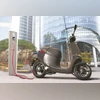
 "ola electric two wheeler ev")
India’s electric two-wheeler (e-2W) market continued its steady expansion in 2025, with cumulative registrations crossing 1.18 million units between January and November, up from 1.07 million units during the same period last year.
In November, there was a three per cent year-on-year (Y-o-Y) decline in registrations after October’s festive rush. On a month-on-month (M-o-M) basis, the fall was sharper at 17 per cent.
Cumulatively, the first 11 months have seen a 10 per cent growth in volumes, and analysts expect the calendar year to end with around 8-10 per cent growth.
Anurag Singh, advisor at Primus Partners, pointed out that production constraints related to rare earth magnet shortage have affected the industry for a few months. And, it continues to dent production numbers.
“Moreover, as larger players like Ola have not done adequate volumes in the recent months owing to multiple factors, that has dragged down the overall industry volumes,” he said
Also Read

 "Hisashi Takeuchi, Managing Director & CEO, MSIL")
 "Electric vehicle")
 "Mahindra")
 "Corporate Average Fuel Efficiency, CAFE")
 "BYD")
According to him, although there are early adopters of electric vehicles (EVs), there is still a larger preference for internal combustion engine (ICE) vehicles.
Data from the Vahan portal, as of December 1, shows clear dominance by legacy original equipment manufacturers (OEMs) during the 11-month period, even as newer players saw sharp shifts in momentum.
Final Vahan data is being collated, and the numbers may slightly change.
TVS Motor emerged the market leader for January–November, registering 272,874 e-2Ws, the highest among all manufacturers.
The company also topped monthly sales in November. Bajaj Auto retained the second position, cumulatively, with 250,366 units registered in the first 11 months of the year. It has reinforced the growing strength of its Chetak-led electric portfolio.
Among newer-age EV specialists, Ola Electric held on to third place on a cumulative basis, with 190,088 registrations between January and November, although the gap with competitors narrowed significantly.
Ather Energy followed closely with 183,163 units, leaving a difference of less than 7,000 vehicles between the two by the end of November.
November data highlighted a notable reshuffling in monthly rankings. Total industry registrations stood at 116,849 units, the second-highest monthly volume recorded this year.
TVS led the month with 30,309 units, translating to around 26 per cent market share. Bajaj followed with 25,526 units, while Ather Energy ranked third with 20,323 registrations.
In a significant development, Hero MotoCorp’s Vida brand surged to fourth place in November, registering 12,199 units and overtaking Ola Electric for the first time in monthly sales.
Ola Electric registered 8,400 units in November, marking a 71 per cent Y-o-Y decline from 29,322 units sold in November 2024.
Despite the weak November showing, Ola continues to stay marginally ahead of Ather on a cumulative basis for the January–November period.
However, the narrowing gap signals intensifying competition among the top four players.
Overall, the January–November data underscores a clear trend: legacy two-wheeler manufacturers TVS and Bajaj are now firmly leading India’s electric two-wheeler market.
Newer EV-focused OEMs are battling slowing demand, sharper competition and shifting consumer preferences as the segment matures.
 "Passenger Vehicles, GST, Auto industry, Car sales")
 "Maruti Suzuki, Suzuki")
 "automobile manufacturer, auto PLI firms")
 "Hyundai Q4 FY25 results, Hyundai profit decline, Hyundai model launch plan, Hyundai FY30 roadmap, HMIL export strategy, Unsoo Kim Hyundai, Hyundai EV India")
 "Mahindra SUV XEV 9S launch")

